
Randy's Guide to Eastern France: Alsace, Savoie, and Jura
To view The Wine Country's current selection of wines from Alsace, Savoie & Jura, click here.
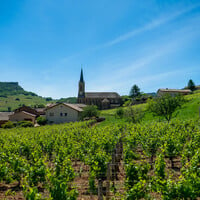
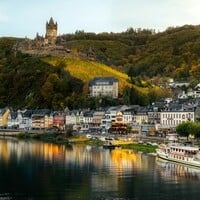
Unless you've visited the magnificent city of Strasbourg with its imposing cathedral and half-timbered buildings, or perused the shops in the canal-town of Colmar, you could be excused from thinking Alsace in this part of eastern France is Germany. At different points of history, you would be right.

But Alsace is undeniably French and undeniably Alsatian, and people there generally view themselves as Alsatian first. The food there is legendary—Michelin stars liberally adorn their restaurants, and their local cuisine, typically choucroute garni (Alsatian sauerkraut and sausages), tarte flambé, foie gras, and Alsatian Meunster, has a French refinement to German-infused dishes.
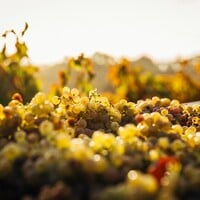
Some of France's most celebrated wine estates are in Alsace with legendary names like Weinbach, Trimbach, and Zind-Humbrecht, which Robert Parker once declared was the greatest winemaker in the world for white wines. Tucked against the hillsides in between the Vosge Mountains and the Rhine River, the narrow north-to-south Alsace region produces some of the world's most elegant and food-friendly wines in the world.

Staring at a row of Alsace wines in a good wine store is confusing for the uninitiated. Unlike most Old World wines, they are labeled by variety (Sylvaner, Gewürztraminer). They are traditionally bottled in German-looking slender hock bottles, yet when you drink them, they are distinctive from the same varietals grown just a few miles to the east in Germany's Baden. Unlike traditional wines of the Mosel, Alsatian wines are usually dry wines (with a handful marked vendange tardive and S.G.N., the equivalent of Germany's Trockenbeerenauslese and nearly as expensive), a reality that a casual observer might miss just by looking at the shape of the bottle.
My own personal biases preferring German Riesling were overturned when I put them to a test alongside a dry Alsace Riesling while consuming Julia Child's recipe for choucroute garni (Riesling-cooked sauerkraut with bratwurst and knockwurst, smoked ham hocks, bacon, and onions sautéed in smoked pork fat all baked together to absorb all the drippings). What grows together, goes together!
Along with Riesling, the noble wines of Alsace include Pinot Gris and Gewürztraminer, with Pinot Blanc, Auxerrois, Chasselas, Muscat, and Sylvaner taking over more utilitarian roles. That's not to say the supporting varietals don't make significant wines—they do—and they are most often found as house wines on French family tables. But the big three white varieties rise to levels in Alsace that tower over the rest. Pinot Noir is the main red wine produced there, and though they are getting better with climate change, they rarely rise to the heights found in Burgundy.

South of Alsace, tucked against Switzerland, lies the hilly green farmland of Savoie, much within eyesight of the Alps. Cheese fondue, melted raclette, and quenelles greet tourists, who chase those meals down with the brisk white Jacquére and Roussette wines grown in the Apremont, Jongieux, and Abymes sub-regions. They can be thrilling wines to drink, described as brisk, minerally snowmelt from the Alps. Yes, there are red wines in the Savoie, but like the wines of Alsace, they are in the minority, with grape varieties like Mondeuse, Pinot Noir, and Gamay making lighter reds with more tension.
In between these two regions lies the border wine region of the Jura, perhaps the least-known and most idiosyncratic wine region in France. It is the home of Comté and Morbier cheese and France's greatest chickens come from nearby Bresse.
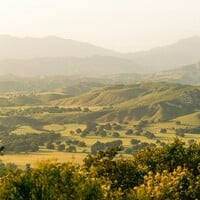
It is a breathtaking region to visit, with dairy farms, rolling hills, white shale cliffs, cascading waterfalls, and small towns and villages that look like they have been locked in time, yet wired for the twenty-first century.

At a stay in a country manor-turned-hotel, we had a most magnificent chicken dish—Bresse chicken medallions in a cream sauce with more Morels than I'd ever seen on a single plate—finished off with a decadent Paris-Brest pastry that had to be shared by two.


The wine specialty in the Jura is the rare Vin Jaune (in one region it is known as Chateau Chalon), the famous "yellow wine" that challenges American palates even more than Spanish dry sherry. It has purposely been oxidized, made "sous voile", under the veil of flor (a protective film of yeast on the surface of wine), which gives it its sherry-like flavor. But the wine has fruit in it, unlike its Spanish counterparts, which makes it totally its own thing, a hybrid of wine and sherry if one were to attempt describe the indescribable.
My first encounter with Vin Jaune was after dinner at Didier Dagueneau's table in Saint-Andelaine. Asked what I thought of the wine, I replied, "it tastes like bad sherry." Beaune Imports owner Michael Sullivan leaned over and said "you'll have to go there and experience this wine in its context." Twenty years later I did, and he was right.
The rich cream, mushrooms, and cheeses of the Jura find their match in the region's wines— Chardonnay (which can resemble aged Meursault), the native Savagnin, and the red varieties Poulsard and Trousseau.
A challenge to consumers is that some of the white wines of the Jura are made "sur voile" and some are not, so it is important to read the labels carefully. Another faux pas of mine that was corrected by Annie Credoz, the proprietress of Domaine Credoz in the hilltop village of Chateau Chalon. When I told her I had served her vin jaune as an aperitif for friends (as I would a fino or an Amontillado sherry), she recoiled.
"Jamais, jamais!' she countered. "Always drink Vin Jaune after dinner, preferably with Comté cheese." I hadn't thought the dry, oxidized specialty was a dessert wine, but I learned my lesson in very stark terms.

Eastern France has three distinctly different wine regions, each with their own personalities, with distinctively different wines. Any wine lover curious to expand their wine knowledge and appreciation owes it to themselves to explore the wines of Alsace, Savoie, and Jura. Short of visiting those places and eating their foods alongside their wines (which I heartily recommend doing), trying out some new recipes with these wines at home is the next best thing.