



The Magic of Russian River Valley – The Home of America’s Greatest Pinot Noirs & Chardonnays, Perhaps?
Back in the Pleistocene era when I was first learning about wine, I had the good fortune to sample a few bottles of excellent red Burgundy and instantly fell under its spell. In the 1970s even a guy on a musician's income could afford a bottle once in a long while.
 Williams-Selyem Winery in the Russian River Valley
While I was waiting for Thanksgiving or any other excuse to drink Gevrey-Chambertin or Pommard, I'd try out every Bourgogne Rouge I could find, which I could afford because they only cost a fraction of the more famous reds, and they, too were Pinot Noirs from Burgundy. Occasionally, I'd find a bottle that would come close to the flavor and depth of the classics. Burgundian Pinot Noirs have a way of creeping into your soul, so you search for similar experiences for the rest of your life.
In those days, California was struggling with Pinot Noir. The great André Tchelistcheff, the legendary winemaker of Beaulieu Vineyards from 1938 to 1973, was a master of Cabernet Sauvignon, but struggled with Pinot Noir. There are two great stories about the elusiveness of California Pinot Noir in the early days involving Tchelistcheff, one he revealed through an interview in Robert Benson's book Great Winemakers of California, and another told by wine writer Dan Berger quoting Robert Lawrence Balzer, wine columnist for the LA Times during the 1960s through the 1980s:
The recollection of this luncheon brings to mind what is perhaps my most haunting remembrance of the Tchelistcheff legend, as it was told to me by the son of the late Captain Joe Concannon, founder of his Livermore Valley winery. André was visiting the winery a couple vintages after his arrival from France (early 1940s.) He spoke of his confusion about the Burgundian Pinot Noir growing in the Napa Valley. Captain Concannon told him to "go into the rose garden of Madame de Latour (owner of Beaulieu Vineyards) and pick one of the most beautiful red roses that is just beginning to come into its full bloom. Take it home and put it into a vase, without any water. The next morning, as it is beginning to fade, put your nose into the heart of that dying rose. The unforgettable scent is the true soul of the wine from this noble vine, grown either here, or in France, most often cloaked, but not obscured, by the incense of the oak in which the wine has been aging to its aristocratic maturity."
The trouble with Pinot Noir in California, Tchelistcheff would later say in Great Winemakers of California, was that "we have the variety, the climate, but not the soil. Accidentally we occasionally get good Pinot Noirs as a result of the other ecological factors: tonnage, seasonal climate or submicroclimate, humidity, early maturity. These factors give us, without the gravel, accidentally, this great complexity. That happened to me in 1946 in the Pinot Noir of Beaulieu and partially in 1947 and in the 1968. But you see I spent 35 years working there and if I count three vintages of a high standard that's all I accomplished with it in my life." He mentioned Forestville in Sonoma County (among a handful of other places) as a possible site for Pinot Noir because of its "poor, gravelly slopes."
Forestville is smack dab in the middle of the Russian River Valley.
The Search for Great California Pinot Noir
I vividly remember my search for California Pinot Noir that could approach the flavors of Burgundy in the 1970s, and how many disappointing bottles I went through—some vegetal, some stemmy, some bland—before I'd discover one that had the black cherry aromas and flavors (if not the complexity) I was searching for, then I'd buy all I could afford. I'd heard about an outstanding Pinot made by Dick Graff at Chalone Vineyards in the Pinnacles inland from Monterey, but I never saw a bottle until many years later. It became California's first "cult wine." It was grown in rare limestone soil, and André Tchelistcheff described the result:
"I am going to tell you, honestly, as a winemaker of certain prestige, not greatness, but of a certain prestige, that I tasted recently, in the company of Dick Graff and my wife, a 1969 Pinot Noir of his, and I put myself on my knees. It was a great, great Pinot Noir."
So there it was. A handful of "tucked away little places", as Miles described Pinot Noir vineyards in Sideways. Perhaps the problem was that too many vintners in those days were planting too many varieties side by side in hopes that an occasional motorist would stop in and find something they liked. Anything. Americans were still a decade away from the White Zinfandel and Chardonnay booms. Pinot Noir was being planted as just another variety, in all the wrong places.
There was a revolution about to take place in California winemaking as a lot of new, more sophisticated grape growers honed in on cooler places for their Pinot Noir vines, like Carneros, Monterey, the Santa Rita Hills, Anderson Valley and Oregon's Willamette Valley. Its white Burgundian stablemate Chardonnay wasn't far away. Dijon clones and Pommard clones and purloined suitcase cuttings from unnamed Domaine Romanée Conti vineyards were propagated, and before you knew it, surprising Pinots and Chardonnays began to emerge in these tucked away little places.
The Best Pinots
By the 1980s, the best of all these Pinots seemed to come from Sonoma's foggy Russian River Valley, home of Williams-Selyem, Rochioli, Gary Farrell and others. The white wines, including Gewürztraminer, Sauvignon Blanc and Chardonnay were outstanding, giving off bright, shimmering flavors, and winning top ratings from critics and Best in Show awards in County Fair competitions. But what made the Russian River Valley most exciting was that it became ground zero for top-quality American Pinot Noir. In those days, nearly everyone making Pinot Noir from Russian River grapes—Robert Stemmler, Tom Dehlinger, Joseph Swan—had success with the variety.

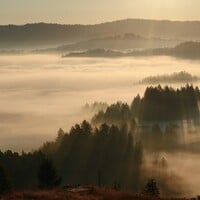
The reason given for Russian River's success, besides clonal selection, was the cool Pacific air and the morning fog of the region, which provided a longer growing season than warmer vineyards on the eastern side of the Mayacamas mountains in Napa Valley.
A Star is Born
In 1983 or 1984 a customer of mine asked if I would join him for Thai food, a cuisine I hadn't tried before. If I would bring a nice bottle of white wine, he'd bring an award-winning red he recently acquired. My selection was a Puligny-Montrachet I'd just discovered at a trade tasting and his was an $8 Pinot Noir from an unknown new winery called Hacienda Del Rio from the Russian River Valley which had just been discovered by Hi-Time Wines in Costa Mesa. (I had heard it won a huge award at the Orange County Fair, but that might be in dispute.)
The Russian River Pinot was spectacular, with all the black cherry I wanted, and it had great balance and just the right amount of weight. (Hint: never drink these wines with hot, spicy Thai food.)
I was to later learn there were only about 300 or 400 cases made and they were sold out at the winery. I learned further that Hacienda Del Rio had received a cease-and-desist letter from another Sonoma winery called Hacienda, forcing the young winery to make a name change.
The next vintage, the young winery's label took the two owner's names as its own, using the same font and design as before. Williams-Selyem was born and decades of legends were to follow.

At about the same time, Cecil DeLoach was dominating fair results and critical acclaim with his Russian River Chardonnays all throughout the 1980s, as did Rochioli and Gary Farrell for their Russian River Valley Pinot Noirs. In 1980, Iron Horse winery released its first sparkling wines.
In later years, terrific wines have been produced with Russian River Valley grapes by the likes of Paul Hobbs, David Ramey, Marimar Estate, DuMol and others, with a special emphasis on Pinot Noir and Chardonnay, two wines whose origins were in Burgundy.
Changes Afoot in the Russian River Valley
Global warming has brought drastic changes to winemaking all over the world and the Russian River Valley was not immune. As Pinot Noir and Chardonnay grapes ripened more, the resulting sugars produced wines whose alcohol crept up year by year. Pinots that begin to resemble Syrah are not Burgundian, not the "queen" of red wines, and not particularly charming. I want to be beguiled by Pinot Noir, not hammered by it.
To this day, I am flummoxed when someone requests a "big, powerful" Pinot Noir. No, no, no, I think. This isn't a cage match. It's Pinot Noir! It's supposed to be lacy, feminine, pretty smelling, and certainly not hot on the tongue.
Even so, even with the occasional excesses of modern-day winemaking and the popular desire for a "palate hit", lurking in many of those Russian River Valley Pinots are the black cherry magic in both aroma and flavor, and when I find a wine that reins in the alcohol and still provides the goodies, I eagerly lap it up.
As for Chardonnay, I think the tide is turning away from buttery, excessively oaky wines which until recently represented the dominant popular style in California winemaking. Although there are still many fans of these wines, more and more present are wines that still look to the great Burgundian Chardonnays for inspiration, with a little brighter acidity and more of their natural terroir emerging.
Chardonnays from the Russian River Valley have the proper bones. While the climate is indeed warmer, there is still that cool Pacific Ocean and the famous fog giving Chardonnay—and Pinot Noir—what they both want, a longer, cooler growing season.
So, you see, I still get excited when I read "Russian River Valley" on a bottle of wine. These are the wines that made me first fall in love with California Pinot Noir, and gave me so many satisfying evenings of great tasting Chardonnay. To this day, I always pause when I observe the name of this great growing region on a bottle and pray that the magic is still there.
It often is.
Wish I could come to the tasting tonight...next time!